Tested by Scripture

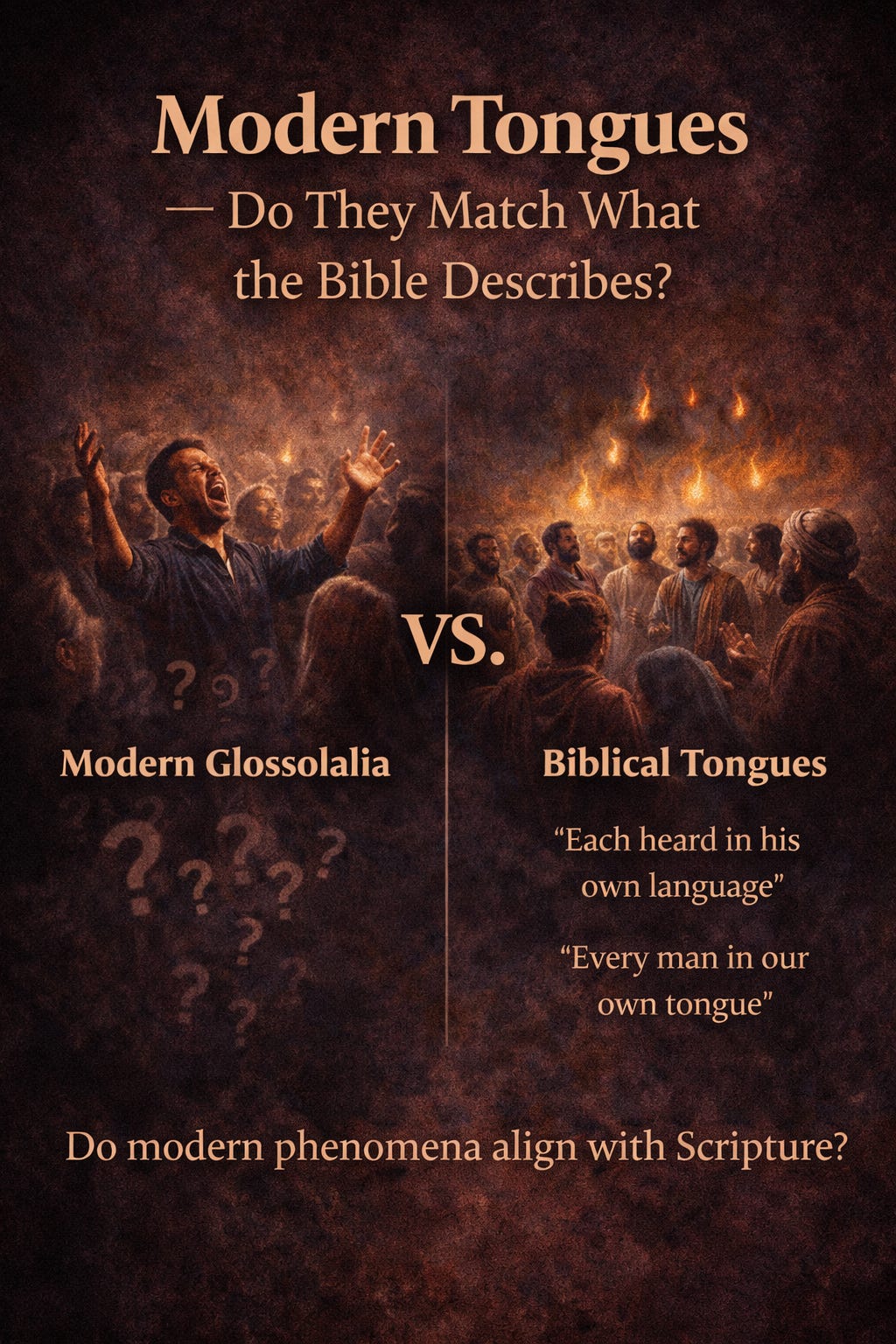
Modern Tongues — Do They Match What the Bible Describes?
In the previous parts of this series, we looked at what the Bible says about tongues. In Acts 2, the disciples spoke real languages that people could understand. In 1 Corinthians 12–14, Paul explained how tongues were to be used in the church—with interpretation, order, and the goal of building up others.
Now we must ask an important question:
Are the tongues we see today the same as the tongues described in Scripture?
To answer this question, we need to look not only at biblical texts but also at what researchers have observed about modern tongues.
Two Different Types of Tongues
Scholars usually describe two different kinds of speech that are sometimes called “tongues.”
The first is xenolalia. This means speaking a real language that the speaker has never learned.
The second is glossolalia. This refers to speech that sounds like language but does not have a clear grammar or consistent meaning.
In Acts 2, the evidence strongly points to xenolalia. People from many different nations heard the disciples speaking in their own languages:
“Every man heard them speak in his own language.” (Acts 2:6, KJV)
But most modern examples of tongues appear to fall into the second category—glossolalia.
This difference is important. The Bible describes understandable languages, while many modern examples do not function that way.
Linguistic Studies
Several linguists have studied recordings of modern tongues.
One of the most well-known studies was done by linguist William J. Samarin. After analyzing many recordings of tongues from Pentecostal meetings, he concluded that the speech patterns did not form a real language system.
He observed that:
The same syllables tend to repeat.
There is no consistent grammar.
There is no stable vocabulary carrying clear meaning.
In other words, the speech sounds like language, but it does not function like a language.
Other researchers have also noticed that the sounds used in tongues often reflect the speaker’s native language. For example, English speakers tend to produce English-like sounds, while speakers of other languages produce patterns shaped by their own language.
This suggests that modern tongues may be influenced by a person’s existing speech habits.
Psychological Factors
Researchers have also studied the environments where tongues commonly appear. Certain conditions tend to make glossolalia more likely:
Repetitive music or rhythms
Highly emotional group settings
Strong expectation that one should receive a spiritual experience
Encouragement from leaders or peers
In some settings, people are even given instructions such as:
“Just open your mouth and begin to speak.”
“Don’t worry about meaning—just let the sounds come.”
Under these conditions, people may produce speech-like sounds spontaneously. This does not necessarily mean the person is being dishonest. Many participants sincerely believe they are experiencing something spiritual.
However, these observations suggest that modern tongues can arise through psychological and social factors.
This is very different from the sudden, untrained languages described in Acts 2.
Similar Phenomena in Other Religions
Another important observation is that speech similar to glossolalia appears in other religious traditions as well.
Anthropologists have documented similar ecstatic speech in various cultures and religions, including certain forms of shamanism and ritual worship.
This does not automatically mean that Christian experiences are identical to those practices. But it does show that unusual vocal expressions can occur in many religious settings.
Because of this, we must be careful not to assume that every unusual spiritual expression is necessarily the work of the Holy Spirit.
The Need for Discernment
The Bible repeatedly calls believers to test spiritual experiences.
John writes:
“Beloved, believe not every spirit, but try the spirits whether they are of God.” (1 John 4:1, KJV)
Paul says:
“Prove all things; hold fast that which is good.” (1 Thessalonians 5:21, KJV)
The standard for testing spiritual experiences is Scripture. Experiences should not define doctrine. Instead, doctrine should evaluate experiences.
A Tension Between Scripture and Practice
When we compare modern tongues with the biblical descriptions, some questions naturally arise.
In Acts 2, tongues were understandable languages.
In 1 Corinthians 14, tongues required interpretation.
They were spoken one at a time and under clear order.
But in many modern settings, tongues occur simultaneously among many people, without interpretation and without clear meaning.
This difference does not automatically settle the debate, but it does raise important questions that must be considered carefully.
Conclusion
Modern tongues may be sincere experiences for many people. But sincerity alone does not determine whether something matches the biblical description.
Scripture shows that tongues were:
understandable languages
connected to gospel proclamation
used with order and interpretation in the church
Modern glossolalia often looks very different.
This does not mean we should approach the issue with hostility. But it does mean we must examine all things carefully in the light of God’s Word.
In the next part of this series, we will look at the history of the modern Pentecostal movement and how the doctrine of tongues developed in the early twentieth century.